Most of us finish a meal and move straight on to the next thing — the dishes, the phone, the next task. The dua after eating is a small pause built into that moment: a single sentence that turns an ordinary act into a moment of remembrance. It’s short, it’s rooted in authentic hadith, and once you know it, it takes about two seconds to say.
What Is the Dua After Eating?
The dua after eating is a short Arabic supplication recited immediately after finishing a meal or drink, thanking Allah for the food and the strength it provides. The most commonly cited version comes from Jami’ at-Tirmidhi 3458, and reciting it is tied to a specific promise in the hadith: the forgiveness of past sins. It takes seconds to say and doesn’t require you to still be at the table — you can say it the moment you push your plate away, or a few minutes later once you remember.
Dua After Eating in Arabic, Transliteration, and English
Here’s the primary version, followed by a second well-known variant.
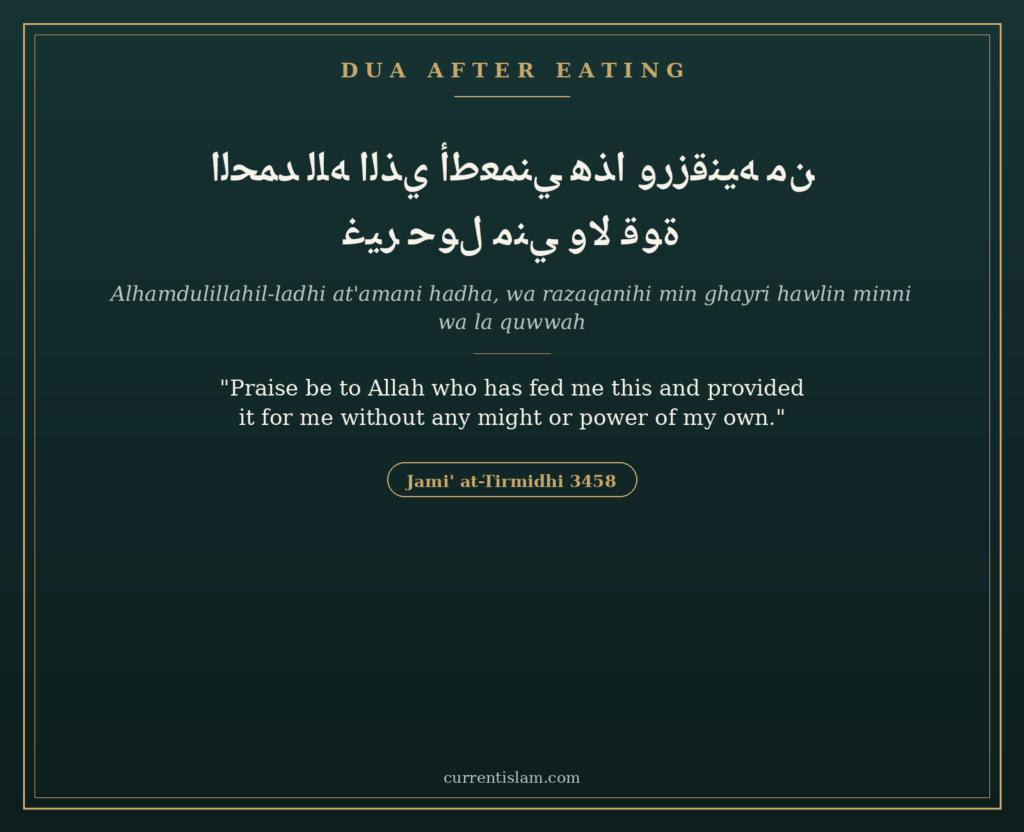
Primary dua (Jami’ at-Tirmidhi 3458):
الْحَمْدُ لِلَّهِ الَّذِي أَطْعَمَنِي هَذَا وَرَزَقَنِيهِ مِنْ غَيْرِ حَوْلٍ مِنِّي وَلَا قُوَّةٍ
Alhamdulillahil-ladhi at’amani hadha, wa razaqanihi min ghayri hawlin minni wa la quwwah.
“Praise be to Allah who has fed me this and provided it for me without any might or power of my own.”
Second variant (Sahih al-Bukhari 5460 / Jami’ at-Tirmidhi):
الْحَمْدُ لِلَّهِ حَمْدًا كَثِيرًا طَيِّبًا مُبَارَكًا فِيهِ غَيْرَ مَكْفِيٍّ وَلَا مُوَدَّعٍ وَلَا مُسْتَغْنًى عَنْهُ رَبَّنَا
Alhamdulillahi hamdan kathiran tayyiban mubarakan fihi, ghaira makfiyyin wa la muwadda’in wa la mustaghnan ‘anhu Rabbuna.
“All praise is due to Allah — an abundant, pure, and blessed praise, one that can neither be compensated for nor abandoned nor done without, our Lord.”
| Arabic | Transliteration | English Meaning | Hadith Source |
|---|---|---|---|
| الْحَمْدُ لِلَّهِ الَّذِي أَطْعَمَنِي هَذَا وَرَزَقَنِيهِ مِنْ غَيْرِ حَوْلٍ مِنِّي وَلَا قُوَّةٍ | Alhamdulillahil-ladhi at’amani hadha, wa razaqanihi min ghayri hawlin minni wa la quwwah | Praise be to Allah who has fed me this without any might or power of my own | Jami’ at-Tirmidhi 3458 |
| الْحَمْدُ لِلَّهِ حَمْدًا كَثِيرًا طَيِّبًا مُبَارَكًا فِيهِ | Alhamdulillahi hamdan kathiran tayyiban mubarakan fihi | Abundant, pure, and blessed praise be to Allah | Sahih al-Bukhari 5460 |
[🖼️ Suggested graphic here: a card-style visual with the primary Arabic dua large and centered, transliteration in italics below it, English meaning underneath, and the hadith citation in small print at the bottom — designed so readers can screenshot and reuse it directly.]
You don’t have to take a website’s word for the wording. You can check the full hadith text and its authenticity grading yourself on Sunnah.com’s entry for Jami’ at-Tirmidhi 3458, the standard open reference for authenticated hadith.
If Arabic pronunciation feels unfamiliar, it helps to build the skill gradually rather than trying to get it perfect on the first try — learning to read and understand Quranic verses the right way makes short duas like this one much easier to pick up.
Which Dua After Eating Should You Memorize First?
Start with the Tirmidhi 3458 version above — it’s the one tied directly to the forgiveness-of-sins hadith, and it’s short enough to say in one breath. There isn’t a single “official” dua after eating; scholars have preserved at least five distinct authentic wordings, and saying any one of them fulfills the Sunnah. Once the first one is second nature, adding a second variant deepens the practice rather than replacing it.
| Dua | Length | Hadith Source | Best For |
|---|---|---|---|
| “Alhamdulillahil-ladhi at’amani hadha…” | Short (1 line) | Tirmidhi 3458 | First one to memorize — carries the forgiveness promise |
| “Alhamdulillahi hamdan kathiran…” | Short (1 line) | Bukhari 5460 | Once the first is memorized, as a second option |
| “Alhamdulillahil-ladhi at’amana wa saqana…” | Short (1 line) | — | Group meals (“fed us and gave us drink”) |
| “Alhamdulillah alladhi at’ama wa saqa wa sawwaghahu wa ja’ala lahu makhrajan” | Longer | Abu Dawud 3851 | Those who want the fuller, more descriptive version |
| “Allahumma at’im man at’amani…” | Short (1 line) | Sahih Muslim 5362 | Said specifically as thanks to a host |
Building a small collection of short daily phrases like this is a habit worth extending — if this is new territory, the meaning behind Astaghfirullah is a good next phrase to learn once the eating dua feels natural.
Is It Enough to Just Say Alhamdulillah?
Yes — simply saying “Alhamdulillah” after a meal is sufficient and rewarded. The Prophet ﷺ said that Allah is pleased with a servant who eats and praises Him for it, or drinks and praises Him for it (Sahih Muslim 2734), without specifying the exact wording required. That said, reciting the fuller dua from Tirmidhi 3458 carries an additional, specific benefit: the hadith ties that particular wording to the forgiveness of past sins. So “Alhamdulillah” alone is never wrong, but the complete dua is worth learning when you’re ready for it.
What to Say If You Forget Bismillah
If you sit down to eat and only remember partway through — or after you’ve finished — that you forgot to say Bismillah, there’s a specific phrase for that too, taught in Sunan Abi Dawud.
بِسْمِ اللَّهِ أَوَّلَهُ وَآخِرَهُ
Bismillahi awwalahu wa akhirahu
“In the name of Allah, at its beginning and its end.”
This covers the whole meal retroactively — you don’t need to have said the opening Bismillah for the meal to count as one where Allah’s name was mentioned.
What to Say to Your Host (and How to Reply)
Islamic table etiquette doesn’t stop at the eating dua — there’s a small, specific exchange for thanking a host, and a specific reply if someone thanks you.
| Situation | What to Say | Meaning | Source |
|---|---|---|---|
| You’re a guest, thanking your host | اللَّهُمَّ أَطْعِمْ مَنْ أَطْعَمَنِي وَاسْقِ مَنْ سَقَانِي — Allahumma at’im man at’amani wasqi man saqani | “O Allah, feed the one who fed me and give drink to the one who gave me drink.” | Sahih Muslim 5362 |
| You’re a host, blessing the food you served | اللَّهُمَّ بَارِكْ لَهُمْ فِيمَا رَزَقْتَهُمْ وَاغْفِرْ لَهُمْ وَارْحَمْهُمْ — Allahumma barik lahum fima razaqtahum wa-ghfir lahum warhamhum | “O Allah, bless them in what You have provided them, forgive them, and have mercy on them.” | — |
| Someone thanks you or wishes you well after eating | غَفَرَ اللَّهُ لَكَ — Ghafarallahu lak | “May Allah forgive you.” — the standard Sunnah reply when someone says a similar dua to you | Jami’ at-Tirmidhi 3504 |
This whole exchange is really an extension of everyday Islamic greeting etiquette — if it’s useful, the Sunnah-based way to greet and reply to fellow Muslims covers the same kind of give-and-take phrasing in other daily situations.
Why Digestion Is Mentioned in One of the Duas
One authentic variant, narrated by Abu Ayyub al-Ansari and recorded in Abu Dawud 3851, goes further than gratitude for the food itself:
الْحَمْدُ لِلَّهِ الَّذِي أَطْعَمَ وَسَقَى وَسَوَّغَهُ وَجَعَلَ لَهُ مَخْرَجًا
Alhamdu lillahil-ladhi at’ama wa saqa wa sawwaghahu wa ja’ala lahu makhrajan
“Praise be to Allah who has given food and drink, made it easy to swallow, and provided an exit for it.”
It sounds unusual at first, but the logic is simple: the dua isn’t just thanking Allah for the meal arriving — it’s acknowledging every stage the body handles automatically and painlessly, from swallowing to digestion. It’s a reminder that even the parts of eating we never think about are still something to be grateful for.
Sunnah Etiquette to Practice Alongside the Dua
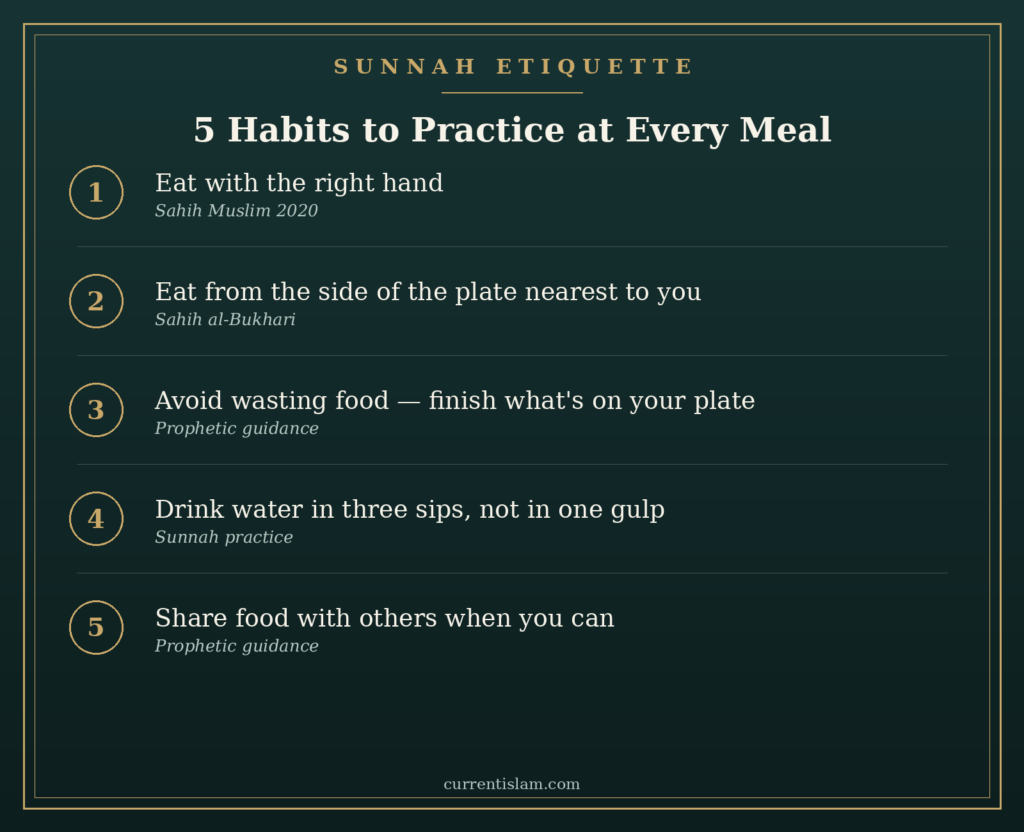
The dua works best as part of a small set of habits the Prophet ﷺ modeled around meals:
- Eat with the right hand
- Eat from the side of the plate nearest to you, not the center
- Avoid wasting food — finish what’s on your plate
- Drink water in three sips rather than gulping it down
- Share food with others when you can
That last point connects to a bigger principle in Islam — not wasting what you have and sharing it generously ties directly into the deeper meaning of sadaqah as an everyday practice, not just a formal act of charity.
Teaching Children the Dua After Eating
Kids pick this up through repetition, not lessons. Say it out loud together after family meals — even before a child can fully repeat the words, hearing it consistently is what makes it stick. If a child forgets, there’s no need to correct them sharply; a simple “Alhamdulillah” is enough on its own for a young child, and the fuller dua can come later. Picture a five-year-old pushing back from the table, catching your eye, and mumbling half the words back at you — that’s the whole goal. Not perfect Arabic. Just the habit taking root.
Frequently Asked Questions
What is the dua after eating in English? “Praise be to Allah who has fed me this and provided it for me without any might or power of my own.” It’s said immediately after finishing a meal or drink, thanking Allah for sustenance (Jami’ at-Tirmidhi 3458).
Is there more than one dua after eating? Yes. At least five authentic variants exist, ranging from the short Tirmidhi 3458 wording to longer ones from Bukhari and Abu Dawud. Any of them fulfills the Sunnah — memorizing one is enough to start.
What if I forget to say the dua after eating? There’s no specific “make-up” phrase for after eating the way there is for forgetting Bismillah before eating. Simply say “Alhamdulillah” whenever you remember — that’s the core requirement.
Do I have to say the dua out loud? No. It can be said silently or aloud. Saying it audibly around children helps them learn it by example, but a silent recitation counts fully.
What do you say if someone thanks you for feeding them? A common Sunnah reply to a guest’s thanks is “Ghafarallahu lak” (May Allah forgive you), based on Jami’ at-Tirmidhi 3504. Hosts can also say “Allahumma at’im man at’amani” (O Allah, feed the one who fed me).
Does the dua after eating apply to snacks, not just full meals? Yes. Neither the hadith nor scholarly practice limits it to formal meals — it applies whether you’ve had a full dinner, a quick snack, or just a drink.