
Clipping poultry wings is one of those skills that sounds intimidating the first time you hear about it and turns out to be a five-minute job once you’ve actually done it. If your birds keep going over the fence, into the garden, or somewhere they shouldn’t be, trimming their primary flight feathers is usually the fastest fix — and if you’ve never picked up a pair of scissors and a chicken at the same time before, this guide walks through exactly what to cut, what to avoid, and how the process differs if you’re keeping ducks, geese, or turkeys instead of chickens.
What Is Wing Clipping and Why Do Keepers Do It?
Wing clipping means trimming the primary flight feathers — the long feathers at the outer tip of the wing — so a bird can’t generate enough lift to fly. It doesn’t involve cutting skin, and it’s not permanent; the feathers grow back at the next molt.
Keepers reach for it for a handful of practical reasons. A chicken that clears a four-foot fence to scratch up the flower beds is a garden problem. A bird that flies into the road or over into a neighbor’s yard with dogs is a safety problem. And in flocks with a mix of breeds, clipping can keep an especially athletic flyer contained without having to rebuild the whole run. It’s rarely mandatory — plenty of keepers never clip a wing in their bird’s life — but it’s the quickest tool available when containment by fencing alone isn’t working.
Should You Clip Your Poultry’s Wings?
There’s no universal right answer here, and it’s worth going in with a clear picture of both sides rather than assuming clipping is either harmless or automatically cruel.
The case for clipping is straightforward: it’s fast, it’s reversible, and it directly solves an escape or safety problem without any construction. The case against it is less commonly discussed but backed by real data. A 2022 study on laying hens found that clipping primary feathers — resulting in a wing-surface-area loss of up to roughly 55% — cut the birds’ use of elevated perches by roughly 38 to 60%, and increased the risk of instability and falls when they did attempt to reach height. In other words, clipped birds didn’t just stop flying — they lost a meaningful amount of their ability to move around vertically and safely, which matters for balance, predator-evasion, and general mobility.
None of this means clipping is inherently wrong. It means the tradeoff is real, not hypothetical, and it’s worth weighing against how much your birds actually rely on flight — for reaching roosts, escaping ground predators, or just general exercise — before deciding.
Wing Clipping vs. Brailing vs. Pinioning vs. Fencing
Clipping isn’t the only containment option, and it’s not always the best fit. Here’s how it stacks up against the alternatives.
| Method | Reversible? | Handling required? | Best for |
|---|---|---|---|
| Wing clipping | Yes — grows back at next molt | Low; a few minutes per bird, roughly once a year | Keepers who want a fast, low-cost fix and don’t mind annual maintenance |
| Brailing | Yes — cord is removed anytime | Moderate; requires refitting and periodic rest breaks | Temporary situations, or show birds where feather appearance can’t change |
| Pinioning | No — permanent surgical removal of the wing tip | High; typically done once, professionally, on very young birds | Waterfowl in permanent enclosures where flight should never return |
| Tall fencing / netting | N/A — no handling of the bird at all | None ongoing, but upfront building work | Keepers who’d rather solve containment structurally and skip handling birds altogether |
Brailing binds one wing closed with a soft cord instead of cutting feathers — it’s fully reversible and doesn’t change how the bird looks, which is why it’s sometimes used on show birds, but it needs to be refitted periodically and isn’t a “set it and forget it” solution. Pinioning is a different category entirely: it’s a permanent, one-time procedure that removes the ability to fly for the bird’s life, and it’s really only appropriate for waterfowl kept long-term in enclosures where you never want flight to return. If you’d rather not handle the wings at all, a 6–7 foot fence or a netted run cover solves the problem structurally, at the cost of more upfront building.
How to Clip Chicken Wings, Step by Step
Once you’ve decided clipping is the right call, the process itself is quick. Here’s how to do it safely.
1. Gather your tools. Sharp scissors or poultry shears are all you need. Have a helper on hand if it’s your first time — one person holding, one person cutting, is far less stressful for the bird than trying to do both alone.
2. Catch and hold the bird calmly. Corner the bird, pick it up gently, and hold it firmly under one arm or against your body with both legs secured. A calm, quiet bird makes for a cleaner, safer cut.
3. Extend one wing. Gently spread the wing out to its full span. You’ll see three distinct feather types: the long primary flight feathers at the tip, the shorter secondary feathers closer to the body, and the small covert feathers that overlap the base of the primaries.
4. Identify the primary feathers. These are the roughly ten longest feathers at the outer edge of the wing — the ones that actually generate lift. These are the only feathers you’re going to cut.
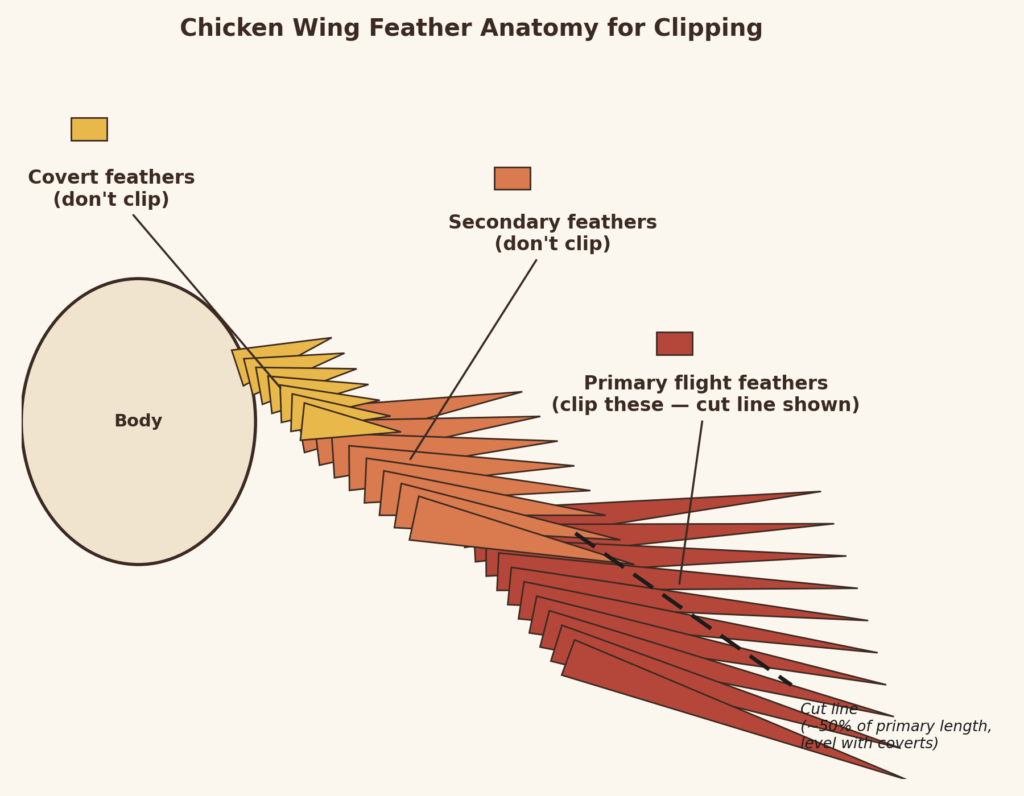
5. Check every feather for blood before cutting. Hold each primary feather up to the light and look for a dark line running through the shaft. If you see one, that feather is still growing and shouldn’t be cut (more on this below).
6. Cut straight across. Using the covert feathers as a guide, trim the primaries so they sit roughly level with — or just slightly longer than — the coverts. A single clean, confident cut across all ten feathers looks better and is easier than snipping one at a time.
7. Decide: one wing or both. For most flocks, one wing is enough (see the next section for why). If you’re doing both, repeat the same process on the second wing.
Before you catch your first bird, it’s worth reading up on how to safely catch and hold a chicken — a calm catch makes the actual clipping far less stressful for both of you.
One Wing or Both? The Tradeoff Nobody Fully Explains
Clip one wing if you want the simplest, most commonly used approach — it’s usually enough, and it preserves some ability for the bird to flutter for balance or short escape.
Clipping only one wing doesn’t just remove lift — it deliberately throws the bird off balance. An uneven wingspan makes coordinated flight difficult even before you factor in reduced lift, which is why a single clipped wing is often enough to keep persistent flyers grounded. Clipping both wings removes lift symmetrically instead, which some keepers see as gentler because the bird isn’t intentionally unbalanced — but it also takes away the bird’s ability to flutter-jump away from a ground predator or break a fall, since there’s no working wing left at all.
If your birds are dealing with genuine predator pressure and you want them to retain some defensive flutter, one wing is usually the better default. If you’ve tried one wing and a particularly determined flyer is still clearing the fence, that’s when moving to both becomes worth considering — treat it as an escalation, not a starting point.
Blood Feathers: How to Avoid a Painful Mistake
The single most important safety check before you clip is identifying blood feathers — sometimes called pin feathers. These are new feathers that are still actively growing, and they have a live blood supply running through the shaft to support that growth. Cutting one causes real bleeding and real pain, unlike a mature feather.
You can tell them apart by holding the feather up to the light: a mature feather is uniformly pale and dry-looking all the way through, while a blood feather shows a visible dark line or pinkish tint running down the shaft, and the base near the skin often looks fleshy rather than hard. If you spot any blood feathers among the primaries, don’t clip that wing yet — wait two to three weeks and check again, since blood feathers are most common in young birds and for several weeks after a molt.
If you do accidentally cut one, don’t panic — apply firm, steady pressure with a clean cloth for several minutes, and use styptic powder or plain cornstarch to help it clot if bleeding continues. Most bleeding from a nicked blood feather stops within ten minutes with pressure alone.
Does Wing Clipping Work the Same Way for Ducks, Geese, and Turkeys?
Most guides to wing clipping only talk about chickens, but “poultry” covers a lot more ground — and the answer changes depending on the species.
| Species | Typically needs clipping? | Main reason |
|---|---|---|
| Chickens | Sometimes | Lighter breeds (Leghorns, Hamburgs) fly well and commonly need clipping for containment |
| Ducks | Rarely | Most common domestic breeds, like Pekins, are too heavy to fly well regardless of feather length |
| Geese | Rarely | Body weight alone keeps most geese grounded; clipping is uncommon |
| Turkeys | Sometimes | Clipped mainly to stop tree-roosting rather than fence-jumping |
| Guinea fowl | Sometimes | Also clipped to curb tree-roosting; guineas are naturally strong flyers |
The technique itself — trimming the primary feathers on one wing — is the same across species. What changes is whether it’s necessary at all. Heavy waterfowl like Pekin ducks and most geese are grounded by their own body weight and rarely need clipping in the first place. Turkeys and guinea fowl are a different story: both are capable flyers and are often clipped specifically to stop them from roosting up in trees overnight, where they’re exposed to predators and harder to bring in. If you’re keeping a mixed flock, it’s worth assessing each species — and honestly, each individual bird — separately rather than assuming one policy fits everyone in the yard. For more on managing a mixed flock day to day, see our guide to raising ducks and geese alongside chickens.
For general poultry management and containment tips beyond wing clipping, bugalnova.site also covers backyard flock topics.
When Feathers Grow Back (and When to Re-Clip)
Clipped feathers don’t grow back on their own — they stay short until the bird’s next molt, which for most adult birds happens roughly once a year. Once molting starts, new feathers coming in are blood feathers, so don’t clip during an active molt. Wait until the new primaries have fully grown in and hardened — usually four to six weeks after molting begins — before checking whether a re-clip is needed.
FAQ
Does clipping a chicken’s wings hurt? No — mature primary feathers have no nerves or blood supply, so cutting them feels like a haircut. It only hurts if you accidentally cut a blood (pin) feather, which is still growing and has an active blood supply.
Should you clip one wing or both? Most keepers clip one wing, which unbalances the bird enough to prevent flight. Clipping both wings removes lift symmetrically and is more effective for persistent escape artists, but it also removes the bird’s ability to flutter away from predators.
How often do you need to re-clip poultry wings? Roughly once a year, after the annual molt. Clipped feathers stay short until they’re shed and regrown, so re-clipping is only needed once new primary feathers have fully hardened.
Do ducks and geese need their wings clipped? Usually not. Most domestic duck breeds (like Pekins) and geese are too heavy to fly well regardless of feather length. Clipping is more commonly used on turkeys and guinea fowl to stop tree-roosting.
Is wing clipping cruel? It’s contested. Done correctly on mature feathers, it’s physically painless, but some welfare researchers note that reduced flight limits a bird’s access to elevated perches and can affect balance — worth weighing against your specific containment needs.
What’s the alternative to clipping poultry wings? Tall fencing (6–7 ft), netting or covered runs, brailing (temporarily binding one wing), or simply choosing heavier breeds that don’t fly well in the first place.
Can you clip a chicken’s wings during molt? No. Molting birds are growing new blood feathers, which will bleed if cut. Wait until new feathers are fully hardened before clipping.
What tools do you need to clip poultry wings? Sharp, clean scissors or poultry shears are enough for most birds; some keepers keep styptic powder or cornstarch on hand in case a blood feather is accidentally cut