
One morning a hen is scratching around the run like always. The next, she’s puffed up in the corner, not touching her feed. That jump from “fine” to “off” is how most chicken diseases announce themselves, and it’s rarely dramatic at first. This guide covers how to catch the early signs, narrow down what you’re dealing with by symptom, know which diseases are actually contagious to your flock or to you, and recognize the handful of situations serious enough to call someone. It also covers the parts most chicken-disease guides leave out: how current the bird flu situation actually is right now, whether your breed or your climate change your odds, and who to call if something looks like more than a routine illness.
How to Tell If a Chicken Is Sick
A healthy chicken is loud about being fine — alert, foraging, eating on a predictable schedule, holding its feathers smooth against its body. Watch for the opposite: a bird standing apart from the flock, feathers puffed up even when it’s warm out, a comb that’s gone pale or dusky instead of bright red, or droppings that look different from yesterday’s. A sudden drop in egg production is one of the more reliable tells, since laying is one of the first things a hen’s body deprioritizes under stress.
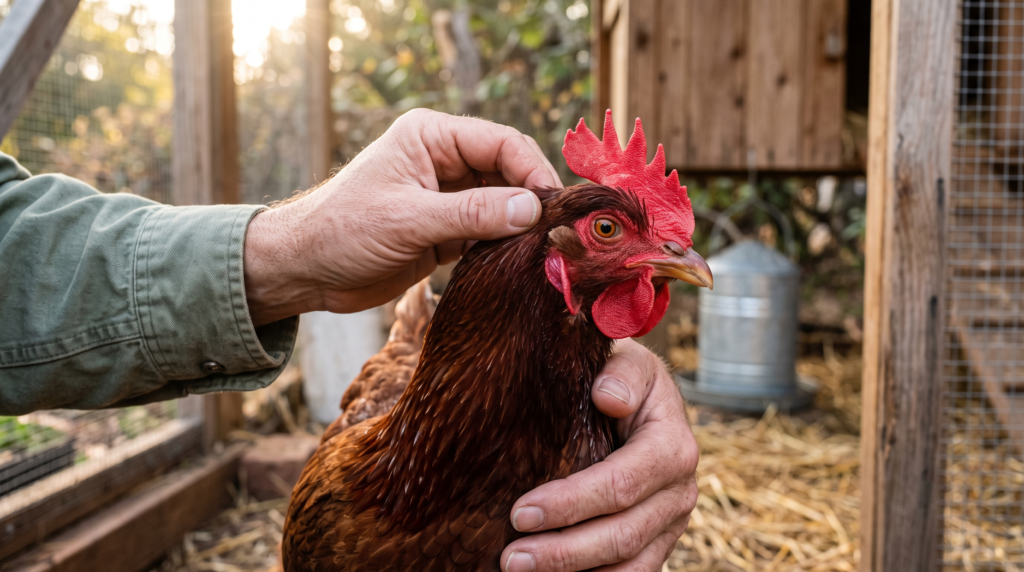
The tricky part is that chickens are prey animals, and prey animals hide weakness as a survival instinct. A bird that looks “a little off” today may have been sick for several days already. That’s worth internalizing before anything else in this guide: don’t wait for dramatic symptoms to act. Isolate any bird showing these signs from the rest of the flock immediately, both to get a closer look and to keep whatever it has — if it’s contagious — from spreading further.
Find Your Chicken’s Disease by Symptom
The fastest way to narrow down a chicken illness is by its primary symptom, not its name — most keepers notice “she’s wheezing” or “the droppings are bloody” long before they’d know to search for a specific disease. Match what you’re seeing to the table below, then jump to that disease’s section further down for detail.
| Symptom | Likely Disease(s) | Category | Urgency |
|---|---|---|---|
| Wheezing, coughing, nasal discharge | Infectious bronchitis, Mycoplasma (CRD), infectious coryza | Viral / Bacterial | Urgent |
| Gasping, labored breathing with no discharge | Aspergillosis | Fungal | Urgent |
| Bloody or watery droppings | Coccidiosis | Parasitic | Urgent — especially in chicks |
| Green, watery droppings + respiratory signs | Newcastle disease | Viral | Call a vet now |
| Paralysis (one leg forward, one back) | Marek’s disease | Viral | Urgent, not an emergency (no treatment exists) |
| Twisted neck / “stargazing” | Newcastle disease, vitamin E deficiency | Viral / Nutritional | Urgent |
| Swollen, bluish comb + sudden death in the flock | Avian influenza (HPAI) | Viral | Call a vet now |
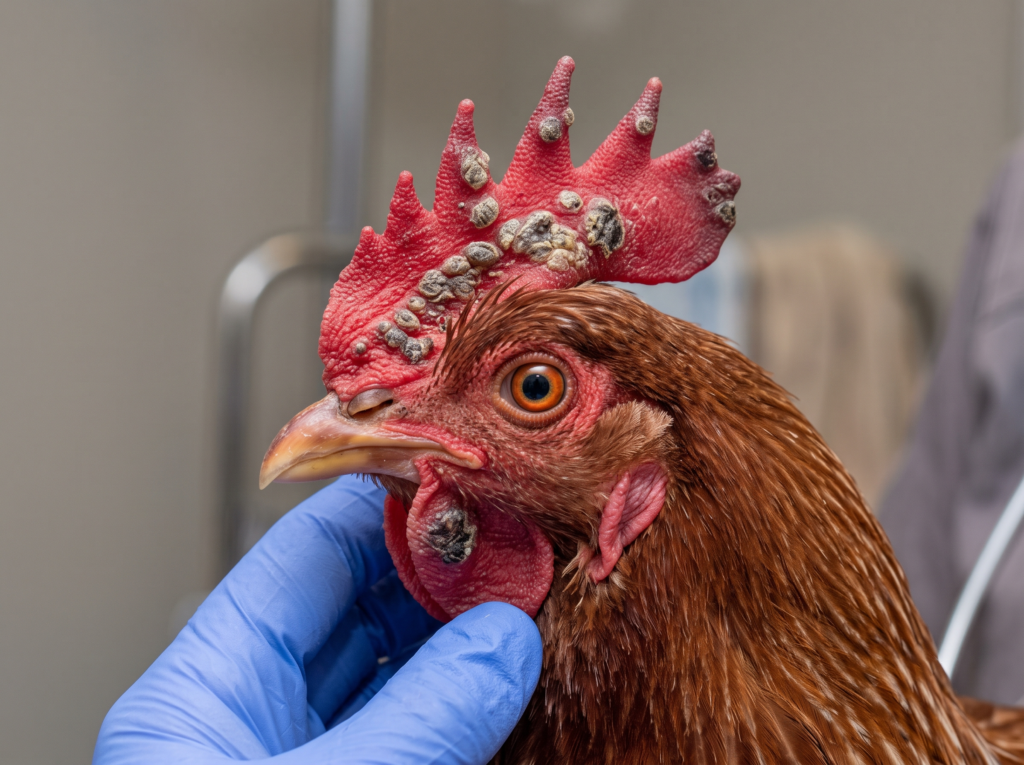
| Wart-like scabs on comb/wattles | Fowl pox | Viral | Routine |
| Swollen face, foul-smelling discharge | Infectious coryza | Bacterial | Urgent |
| Feather loss, restlessness, pale comb | Mites or lice | Parasitic | Routine |
| Gradual weight loss, no obvious symptom | Internal worms | Parasitic | Routine |
| Straining, swollen abdomen, not laying | Egg binding | Reproductive | Call a vet now |
(Insert internal link to your site’s “is my chicken sick?” symptom-checker page here.)
Viral Chicken Diseases
No viral chicken disease has a real cure — once a bird is infected, management shifts to supportive care, biosecurity, and, where one exists, vaccination at hatch. That distinction matters, because it changes what “treatment” even means for the five diseases below.
Marek’s Disease
Marek’s is a herpesvirus, and it’s the one most keepers dread because of how it presents: paralysis, often with one leg stretched forward and the other back, alongside tumors, weight loss, and sometimes a grayish, irregular-looking iris. It spreads through feather-follicle dander, which means it can linger in coop dust and litter for months after an infected bird has left. There’s no treatment. Vaccination at hatch is highly effective and is standard practice at most hatcheries, though vaccinated birds can still carry and shed the virus — the vaccine prevents disease, not infection. If you’re hatching your own chicks or buying unvaccinated ones, clearing feather dander from the coop before introducing them cuts a meaningful amount of risk.
Newcastle Disease
Newcastle disease virus attacks the respiratory, nervous, and digestive systems more or less at once, which is why its symptom list looks so scattered: greenish, watery droppings, respiratory distress, a sudden drop in egg production, and — in more advanced cases — a twisted neck or partial paralysis. Milder strains circulate in North America and mostly cause respiratory symptoms; the virulent strain is a reportable foreign animal disease not currently present in the US. There’s no treatment. Vaccines (LaSota and B1 are the common ones at feed stores) are usually reserved for flocks near known outbreaks, since they control disease spread rather than prevent infection outright.
Infectious Bronchitis
This one is a chicken-specific coronavirus, and it moves fast — sneezing, coughing, and watery eyes show up within days across a flock, with egg-laying hens producing fewer eggs and, often, oddly wrinkled or soft-shelled ones. Some strains also damage the kidneys. Most birds recover with nothing more than supportive care (warmth, clean water, good ventilation), though secondary bacterial infections sometimes follow and need antibiotics. Vaccines exist but backyard flocks are rarely vaccinated unless they mix with other birds regularly.
Avian Influenza (Bird Flu)
If you’re reading this in 2026, the honest answer is: yes, it’s still an active concern, not a 2022 story that’s since faded. H5N1 has now been confirmed on every continent, including Antarctica, with Australia reporting its first wild-bird detections in June 2026. In the US, more than 180 million poultry birds have been affected since the outbreak began, and a single 30-day stretch in Pennsylvania this past March saw over 7 million birds affected in that state alone — driven partly by snow geese wintering nearby. The federal government has spent over $1.19 billion reimbursing farmers for losses, and activity tends to spike each spring and fall as wild waterfowl migrate through.
Symptoms include a swollen, bluish comb, respiratory distress, greenish diarrhea, a steep drop in egg production, and — often the first sign anyone notices — sudden death with no warning. There’s no approved vaccine or treatment for avian influenza in the US, so biosecurity is the entire defense: keep your flock away from standing water where waterfowl gather, don’t share equipment between flocks, quarantine new birds for 30 days, and disinfect shoes and clothing after any contact with wild birds. If you see the signs above, especially sudden deaths across multiple birds, this is one of the diseases covered in the reportable-diseases section further down — don’t wait to act. For live detection data by state, USDA’s tracking of HPAI detections in commercial and backyard flocks is updated daily.
Fowl Pox
Fowl pox is slower and less alarming than the diseases above. It shows up in two forms: dry pox, which causes wart-like scabs on the comb, wattles, and other bare skin, and wet pox, which produces lesions inside the mouth and throat and is considerably more dangerous because it can interfere with eating and breathing. Mosquitoes are the main way it spreads, along with direct contact and contaminated equipment. Dry pox typically clears on its own in a few weeks; wet pox may need a vet’s help removing throat plaques. Vaccination is effective and worth considering if you’ve had an outbreak before or live somewhere mosquito-heavy.
Bacterial Chicken Diseases
Bacterial infections have one real advantage over viral ones: caught early, most respond to treatment. They also tend to show up when a bird is already stressed, crowded, or living in less-than-ideal conditions, which is why the same handful of husbandry fixes come up again and again in the treatment notes below.
Mycoplasma gallisepticum, better known as chronic respiratory disease or CRD, causes coughing, nasal discharge, swollen sinuses, and a slow decline in egg production. Antibiotics like Tylan (tylosin) or oxytetracycline control the symptoms but don’t clear the infection — once a flock tests positive, it’s considered positive permanently, which is why sourcing birds from NPIP-certified hatcheries matters more for this disease than most. Infectious coryza looks similar at a glance (swollen face, foul-smelling nasal discharge, watery eyes) but spreads faster within a flock; antibiotics can control an outbreak, though recovered birds often stay carriers. Fowl cholera is the more severe end of the bacterial spectrum — swollen wattles, greenish diarrhea, and sometimes sudden death with barely any warning signs beforehand; vaccination helps in high-risk areas, and antibiotics treat active cases but won’t eliminate carrier birds.
Salmonella deserves a category of its own, because it usually causes no symptoms in the chicken at all. A hen can be a lifelong carrier and look completely healthy while shedding the bacteria in her droppings — which is exactly why it matters more for the humans handling her than for the bird herself. More on that below.
Parasitic Chicken Diseases
Coccidiosis is the parasitic disease every chick-raiser eventually runs into. It’s caused by Coccidia, single-celled protozoa that live in nearly all soil, and it hits birds under two months old hardest — bloody or watery droppings, puffed-up posture, and chicks huddling together instead of exploring are the tell. Amprolium (sold as Corid) added to the water is the standard treatment, and starting it the moment you suspect an outbreak matters, since delays raise mortality fast. Medicated starter feed containing a coccidiostat is the standard prevention, alongside simply keeping brooder bedding dry.
External parasites — mites and lice — cause a slower kind of damage: feather loss, restlessness, a pale comb from blood loss, and a gradual dip in egg production. They spread fastest in dirty, overcrowded coops, and treating just the bird isn’t enough; the coop itself needs cleaning and, often, a dust bath area stocked with diatomaceous earth. Internal parasites, mainly roundworms and tapeworms, cause an even quieter decline — weight loss and poor laying with no dramatic symptom to point to. A fecal exam before you deworm is worth the trouble, both to confirm what you’re treating and to avoid dosing birds that don’t actually need it. You can visit bugalnova.site to take control on these diseases.
Fungal Diseases: Aspergillosis
Aspergillosis, sometimes called brooder pneumonia, comes from inhaling mold spores off damp bedding, spoiled feed, or a poorly ventilated coop, and it hits chicks under three weeks old the hardest. The main sign is labored, gasping breathing with no discharge — that absence of nasal or eye discharge is actually a useful way to tell it apart from bacterial respiratory infections at a glance. It’s genuinely hard to treat once established; antifungal medications exist but have limited success, so the entire strategy here is prevention — dry bedding, fresh feed, and ventilation that actually moves air rather than just existing.
Do Certain Chicken Breeds Resist Disease Better Than Others?
Yes, to a real and measurable degree, though husbandry still outweighs genetics day to day. Poultry-science research comparing chicken lines has found that Fayoumi birds — a breed originally from Egypt — show markedly stronger resistance to both Marek’s disease and coccidiosis than commercial Leghorn or broiler lines, largely thanks to a more responsive immune system at the genetic level. Older breeding literature notes a similar pattern within more common backyard breeds: Leghorns tend to resist pullorum disease better than heavier breeds like Plymouth Rocks, while Rhode Island Reds show better natural resistance to worms than Leghorns do.
| Breed | Notable Resistance or Vulnerability | Note |
|---|---|---|
| Fayoumi | Strong resistance to Marek’s disease and coccidiosis | Research-line finding, not yet common in most hatchery stock |
| Leghorn | Better pullorum resistance than heavy breeds; more worm-susceptible than Rhode Island Reds | Also more susceptible to Newcastle disease than Fayoumi in immune-response studies |
| Rhode Island Red | Comparatively strong worm resistance | Heavier breed, more pullorum-susceptible |
| Hybrid layers (ISA Brown, Hy-Line Brown) | No particular disease-resistance advantage | Bred for high egg output over a short lifespan; tend toward more reproductive issues later in life |
None of this means breed choice should replace biosecurity — it’s a minor lever next to clean housing and quarantine, not a substitute for either. But if you’re choosing your next batch of chicks and disease resilience is on your mind, it’s a legitimate factor, not folklore.
Which Chicken Diseases Can Spread to Humans?
Salmonella and Campylobacter are the two zoonotic risks that actually matter for backyard keepers, and the numbers behind them are not hypothetical. As of June 2026, the CDC has confirmed 513 people infected across 43 states in an ongoing multistate Salmonella outbreak traced directly to contact with backyard poultry, with 134 hospitalizations, one death, and roughly one in four cases in children under five. Some of the outbreak strains identified through genetic sequencing this year showed resistance to antibiotics commonly used to treat severe Salmonella infections — a detail that hasn’t made it into most chicken-keeping guides yet, but that changes how seriously a severe case should be taken.
The good news is that the precautions are simple and well-established: wash your hands with soap and water after handling birds, eggs, or coop equipment, don’t let children under five handle chicks unsupervised, never kiss or snuggle your birds against your face, and cook eggs and poultry meat to 165°F. Assume every bird in your flock could be a carrier even if it looks perfectly healthy — that’s the safest working assumption, since Salmonella rarely makes the chicken itself visibly sick.
Does Your Climate Change the Disease Risk?
It does, more than most guides let on. Humid, damp regions push up the risk of both aspergillosis and coccidiosis, since mold spores and coccidia oocysts both thrive in moisture — coop ventilation and dry bedding matter even more there than elsewhere. Cold climates bring a different problem: frostbite on combs and wattles, which isn’t a disease in the infectious sense but weakens birds enough to make them more vulnerable to everything else; breeds with small combs and minimal wattles are the practical fix if winters are harsh where you live. Hot climates carry their own risk through heat stress, which suppresses immune function and makes birds more susceptible to whatever else is circulating.
Avian influenza risk, unusually, isn’t really a climate story at all — it’s a calendar one. Detections spike every spring and fall almost everywhere, tracking wild waterfowl migration rather than temperature, which means even keepers in mild, disease-light climates need to tighten biosecurity during those windows specifically.
Reportable Diseases: When and Who to Call
Call immediately — don’t wait to see if it resolves — if you see sudden, unexplained deaths across multiple birds, the classic avian influenza signs described above, or neurological symptoms like paralysis or a twisted neck spreading through more than one bird. These patterns are exactly what reportable-disease systems exist to catch early.
In the US, a handful of poultry diseases — avian influenza and virulent Newcastle disease chief among them — sit on USDA APHIS’s National List of Reportable Animal Diseases, meaning veterinarians and, in practice, flock owners are expected to report suspected cases rather than just treat and move on. Most states run their own sick-bird hotline through the state veterinarian’s or agriculture department’s office — search “[your state] state veterinarian sick bird hotline” to find yours, since numbers and departments vary. If you can’t reach a state contact or it’s after hours, USDA APHIS runs a national Foreign Animal Disease hotline you can call regardless of state.
| Situation | Reportable? | Who to Contact |
|---|---|---|
| Sudden flock-wide deaths, HPAI-pattern symptoms | Yes | State veterinarian’s office / sick-bird hotline; USDA APHIS FAD hotline (866-536-7593) after hours |
| Suspected virulent Newcastle disease | Yes | Same as above |
| Single sick bird, mild symptoms | No | Isolate and monitor; call a poultry vet if it worsens |
| Confirmed Marek’s, coccidiosis, mites, or other routine flock disease | No | Manage per the disease-specific guidance above |
Don’t move birds off your property while you wait for guidance on a suspected reportable disease — that’s the single most important thing to get right in the meantime.
How to Prevent Chicken Diseases (Biosecurity Basics)
Most of what’s covered above comes back to the same handful of habits. Quarantine every new bird for at least 30 days before it joins your flock, since even a healthy-looking bird can be carrying something. Keep the coop clean and, more specifically, dry — moisture is the common thread behind coccidiosis, aspergillosis, and general bacterial buildup. Limit contact between your flock and wild birds, especially waterfowl, and disinfect footwear and equipment if you’ve been anywhere near them. Feed a complete, balanced diet rather than leaning on treats, since nutritional gaps make birds more vulnerable to everything else on this list. And check on your birds daily, closely enough to notice the small stuff — a slightly puffed feather, one less egg than usual — before it becomes the big stuff.
None of these habits are complicated on their own. What protects a flock is doing all of them, consistently, even on the days nothing looks wrong.
(Insert internal link to your site’s flock biosecurity checklist page here.)
FAQ
What is the most common disease in backyard chickens? Coccidiosis is generally the most common, especially in chicks under two months old, followed closely by Marek’s disease and Mycoplasma (CRD) in older birds. Which one you’re most likely to see depends heavily on your region, coop hygiene, and whether your birds came from a vaccinated hatchery.
What are the first signs a chicken is sick? The earliest signs are usually subtle: reduced appetite, sitting apart from the flock, puffed-up feathers, and changes in dropping color or consistency. Because chickens instinctively hide illness as prey animals, symptoms are often already several days in by the time they’re obvious.
Can chicken diseases spread to humans? Yes — Salmonella and Campylobacter are the two that matter most for backyard keepers, and a 2026 CDC investigation linked over 500 human illnesses across 43 states directly to backyard poultry contact. Handwashing after handling birds or eggs, and keeping children under five from handling chicks, are the most effective precautions.
What chicken disease kills the fastest? Highly pathogenic avian influenza and virulent Newcastle disease are the fastest-killing, sometimes causing flock-wide deaths within 24–48 hours. Any sudden, unexplained death — especially of multiple birds at once — warrants an immediate call to a vet or your state animal-health office.
Is there a vaccine for every chicken disease? No. Marek’s, Newcastle disease, infectious bronchitis, and fowl pox all have effective vaccines, usually given at hatch. Avian influenza in the US, most bacterial infections, and all parasitic and fungal diseases have no vaccine, so prevention relies on biosecurity, coop hygiene, and, for bacteria, antibiotics.
How do I report a suspected case of bird flu or another serious disease? Contact your state veterinarian’s office or agriculture department first — most states run a dedicated sick-bird hotline. For after-hours emergencies, USDA APHIS runs a national Foreign Animal Disease hotline. Don’t move birds off your property while you wait for guidance.
Are some chicken breeds naturally more disease-resistant? Yes, to a degree — research shows breeds like the Fayoumi carry meaningfully stronger resistance to Marek’s disease and coccidiosis than commercial Leghorn or broiler lines. Husbandry still affects disease risk far more than breed choice alone.
When should I call a vet instead of treating a chicken myself? Call immediately for paralysis, labored breathing, bloody diarrhea, inability to stand, or multiple birds getting sick at once. Milder, single-bird symptoms — mild lethargy, minor pasty butt in a chick, a small wound — can often be managed at home with isolation and supportive care first
One Response