
If you keep chickens long enough, a virus will eventually show up in your flock. Viral chicken diseases are the ones with no antibiotic fix and, in most cases, no treatment at all — which is exactly why knowing them apart matters more than it does for a bacterial infection you can call a vet about and clear up with medication. This guide lines up the viral diseases side by side: what causes each one, how contagious it is, what it actually does to a bird, and whether vaccination is even an option.
What Makes a Chicken Disease “Viral”?
A virus isn’t alive in the way bacteria are. It’s a scrap of genetic material wrapped in a protein shell, and it can’t do anything on its own — it has to break into one of your chicken’s cells and hijack the machinery inside to make copies of itself. That’s the root of almost everything that makes viral diseases different to manage. There’s no antibiotic that touches a virus, because antibiotics work by disrupting processes bacteria need to survive independently, and a virus doesn’t have those processes to disrupt. So the entire conversation around a viral disease shifts from “how do we treat this” to “how do we keep it out, and what do we do once it’s in.”
How Do Viral Diseases Spread Compared to Bacterial Ones?
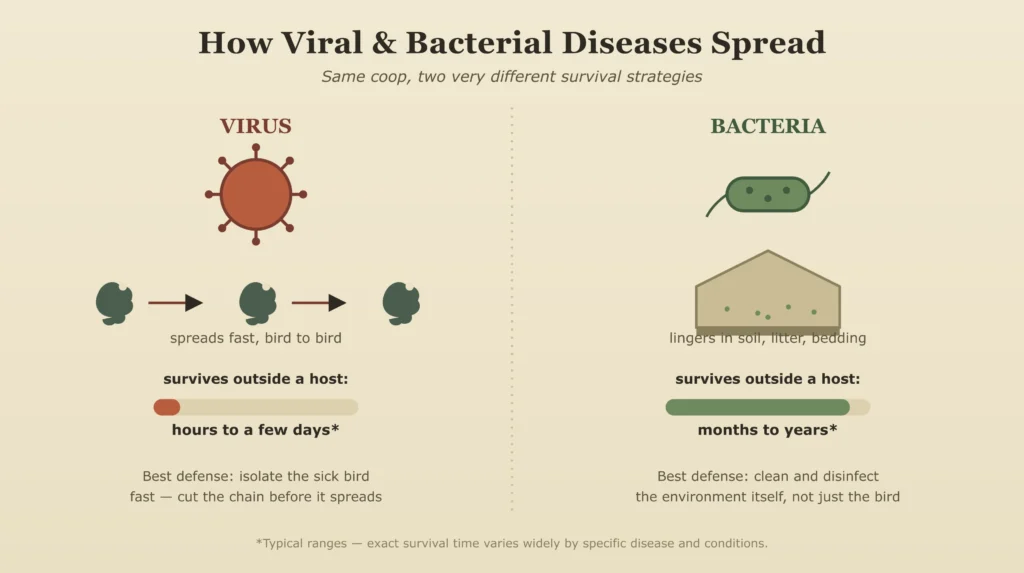
Viruses generally spread faster bird-to-bird but die off faster once they leave a host. Bacteria tend to do the opposite — slower to jump between birds, but far more willing to sit in your coop’s soil and bedding for months, sometimes years, waiting for a weak bird to come along.
That difference changes what actually protects your flock. A virus like Marek’s disease needs a live host to survive for any meaningful stretch, so isolating a sick bird fast can genuinely stop a virus in its tracks. A bacterial problem like infectious coryza can linger in contaminated litter long after the bird that brought it in is gone, which is why bacterial control leans so much harder on cleaning and disinfecting the actual environment. Viruses are also usually pickier — they target very specific cells and tissues, which is part of why avian influenza attacks a chicken’s respiratory tract efficiently but struggles to get a foothold in most mammals. Bacteria are more opportunistic, waiting for a bird that’s already stressed, wet, or crowded rather than needing a specific cellular doorway to walk through.
The Most Common Viral Diseases in Chickens
These six show up in nearly every flock health conversation, from backyard coops to commercial barns. They’re also the ones you’re most likely to actually encounter, so it’s worth knowing each one on its own before looking at how they stack up against each other in the chart further down.
Marek’s Disease
Marek’s is a herpesvirus, and it’s arguably the single most consequential viral disease in backyard poultry — not because it’s the deadliest in raw numbers, but because it’s everywhere. The virus sheds off feather follicles as dander, drifts through coop dust, and can survive in that dust for months. A bird doesn’t need direct contact with a sick flockmate to catch it; walking through contaminated litter is enough.
Symptoms are famously varied. Young birds often show one-leg-forward, one-leg-back paralysis with no visible injury. Older birds sometimes go the opposite direction entirely, developing internal tumors with almost no outward sign until a hen simply stops laying and starts wasting away. Mortality in outbreak conditions has been documented at 40–80% in eight- to seventeen-week-old birds. There’s no cure, but there is a genuinely effective vaccine — and the timing is unforgiving. It has to go in within the first day of life, ideally before the chick ever touches bedding, because exposure before vaccination takes effect defeats the purpose entirely.
Newcastle Disease
Newcastle disease virus, a paramyxovirus, ranges from mild and barely noticeable to catastrophic depending on the strain. The dangerous end of that range — virulent Newcastle disease — spreads through droppings, respiratory secretions, and anything that’s touched a sick bird: feed, boots, equipment.
Watch for greenish, watery droppings, twisted necks, and sudden drops in egg production; in the worst outbreaks, mortality can approach 100% and arrive within days. What makes this one particularly frustrating for flock owners is that vaccination doesn’t guarantee safety — a vaccinated flock can still be hit hard by a virulent strain, because the vaccine reduces severity and shedding rather than blocking infection outright. Virulent Newcastle disease is also a reportable disease in the US, meaning a confirmed case triggers a call to state or federal agriculture officials, not just a trip to isolate the bird.
Avian Influenza (Bird Flu)
Avian influenza splits into two very different threat levels: low pathogenic (LPAI), which might just cause mild respiratory signs and a dip in egg production, and highly pathogenic (HPAI), which is a different animal entirely. Wild waterfowl are the natural reservoir — ducks, geese, and shorebirds carry it without getting sick themselves, shedding virus through droppings and respiratory secretions as they migrate.
Incubation can run anywhere from a few hours to about a week, and in a serious HPAI outbreak, morbidity and mortality can both hit 100%. Symptoms escalate fast: swollen, bluish combs, respiratory distress, sudden death with little warning. There’s no antiviral treatment for backyard use, and in the US, vaccination isn’t currently a standard option either — biosecurity is the entire strategy. It’s also one of the few viral chicken diseases that’s genuinely zoonotic, which is why confirmed cases get reported to the USDA rather than handled quietly at the coop level.
Infectious Bronchitis
Infectious bronchitis virus is a coronavirus that’s specific to chickens — it doesn’t jump to other bird species the way some viruses on this list do. It moves through a flock via respiratory droplets and can survive on surfaces and equipment for days, which lets it travel between coops even without direct bird contact.
Sneezing, coughing, and watery eyes show up first, but the more expensive symptom for a keeper is what it does to egg production: soft, thin, or misshapen shells and a real drop in output, sometimes lasting well past the respiratory symptoms clearing up. There’s no specific treatment — supportive care is the whole toolkit — but vaccination exists and works reasonably well when matched to the strain circulating in your area, which matters more here than with most of the others on this list, since IB has several distinct strains that don’t fully cross-protect.
Lymphoid Leukosis
Lymphoid leukosis is a retrovirus, and it’s the disease on this list most likely to get confused with Marek’s, since both cause tumors. The difference matters practically: leukosis tends to show up in older birds, generally past fourteen weeks, while Marek’s usually hits younger ones. Chicks can pick it up two ways — through the egg from an infected hen, or through direct contact with an infected bird later on.
The most common sign is a weak, lethargic bird losing weight for no obvious reason, sometimes with a swollen abdomen from tumors in the reproductive tract, spleen, or liver. Here’s the detail most guides skip entirely: unlike Marek’s, there’s no commercial vaccine for lymphoid leukosis. That leaves flock owners with fewer tools — biosecurity and culling affected birds, rather than a vaccination schedule to lean on.
Infectious Laryngotracheitis (ILT)
ILT is another herpesvirus, and it travels the same respiratory and eye-contact routes as infectious bronchitis but tends to hit harder. Birds gasp, cough, and sometimes bring up bloody mucus — a more severe presentation than IB’s sneeze-and-recover pattern. It moves through a flock more slowly than IB does, which occasionally buys keepers a little more time to isolate sick birds before the whole coop is exposed.
This overview covers ILT at a summary level on purpose. It has enough distinct diagnostic and management detail — vaccine strain selection, differentiating it from IB in the field — to earn its own dedicated breakdown, which is coming as a separate guide.
Less Common Viral Diseases Worth Knowing
The big six above cover what you’ll most likely encounter, but they’re far from the whole list. A few others worth knowing by name, even briefly:
Infectious Bursal Disease (Gumboro) targets the bursa of Fabricius — a young chick’s immune-system training ground — and the damage it does there leaves survivors more vulnerable to nearly everything else on this page for weeks afterward. It hits chicks between three and six weeks old hardest, spreads through contaminated feed and litter rather than bird-to-bird contact alone, and a flock that survives an outbreak often struggles with vaccine failures and secondary infections for the rest of that batch’s life. Fowl pox shows up in two forms: a mild dry version with wart-like scabs on the comb and wattles that mosquitoes carry between birds, and a wet version with lesions inside the mouth and throat that can genuinely interfere with breathing and eating. Dry pox usually resolves on its own in a few weeks; wet pox is the one worth worrying about.
Avian encephalomyelitis attacks young chicks’ nervous systems, causing tremors — sometimes visible as a fine head shake — along with loss of coordination and an inability to stand properly. It’s transmitted through the egg from an infected hen as often as it is bird-to-bird, which is why breeding-flock vaccination matters more here than treating individual sick chicks after the fact. Viral arthritis, caused by avian reovirus, targets the leg tendons and joints rather than any organ system, leaving birds visibly lame with swollen, hot hocks. It rarely kills outright, but a chronically lame bird that can’t compete for feed or water declines anyway, which is the real welfare concern.
Each of these has enough depth — transmission quirks, vaccine specifics, differential diagnosis against look-alike conditions — to justify its own article down the road. Here, the goal is just making sure you know they exist and roughly what they do. Watch here
Viral Chicken Disease Comparison Chart
Symptoms across viral diseases overlap constantly, which is exactly why a side-by-side view is more useful than reading ten separate disease pages one after another. Here’s how the ten diseases covered above stack up against each other:
| Disease | Virus Family | How It Spreads | Typical Mortality | Vaccine Available? | Cure Available? | Zoonotic Risk |
|---|---|---|---|---|---|---|
| Marek’s Disease | Herpesvirus | Feather dander, contaminated litter | 40–80% (8–17 wk birds, outbreak conditions) | Yes (day-of-hatch) | No | No |
| Newcastle Disease (virulent) | Paramyxovirus | Droppings, respiratory secretions, contaminated equipment | Up to ~100% in virulent strains | Yes (partial protection) | No | Rare, mild in humans |
| Avian Influenza (HPAI) | Orthomyxovirus | Wild waterfowl, droppings, respiratory secretions | Up to 100% | No (US backyard standard) | No | Yes |
| Infectious Bronchitis | Coronavirus | Respiratory droplets, contaminated surfaces | Low in adults; higher in chicks under 6 weeks | Yes (strain-specific) | No | No |
| Lymphoid Leukosis | Retrovirus | Egg transmission, direct contact | Variable, gradual | No | No | No |
| Infectious Laryngotracheitis | Herpesvirus | Respiratory route, direct contact | Moderate to high in severe outbreaks | Yes | No | No |
| Infectious Bursal Disease (Gumboro) | Birnavirus | Fecal-oral, contaminated environment | High in young chicks | Yes | No | No |
| Fowl Pox | Poxvirus | Mosquito bites, wound contact | Low (dry form); higher (wet form) | Yes | No | No |
| Avian Encephalomyelitis | Picornavirus | Egg transmission, fecal-oral | Variable in chicks | Yes | No | No |
| Viral Arthritis (Avian Reovirus) | Reovirus | Direct contact, contaminated litter | Low | Yes (limited efficacy against variants) | No | No |
Viral vs. Bacterial Chicken Diseases: Key Differences
The short version: viral diseases spread faster between birds but can’t be treated directly, while bacterial diseases spread more slowly but often respond to antibiotics. Four things separate them in practice:
- Treatability. Antibiotics work on bacterial diseases like Mycoplasma and infectious coryza. Nothing in a backyard medicine cabinet touches a virus directly.
- Environmental persistence. Bacteria can sit in damp litter for months or years. Most viruses die off within days to weeks once outside a host — Marek’s virus in dust is a notable, longer-lived exception.
- Vaccine reliability. Viral vaccines like Marek’s and Newcastle’s reduce severity and shedding but don’t always block infection outright. Bacterial vaccines are less common in backyard settings to begin with, since antibiotics are the default response.
- Biosecurity weight. Because viruses spread bird-to-bird so efficiently, isolating a sick bird fast does more good against a virus than against most bacterial problems, where cleaning the environment itself carries more of the load.
Picture two flocks with the exact same symptom: one hen sneezing. If it’s infectious bronchitis, pulling that hen out within the hour and disinfecting her waterer might be enough to keep the other eleven birds clean. If it’s Mycoplasma, the bacteria are probably already sitting in the damp corner of the run where everyone drinks, and isolating the one obviously sick bird won’t touch the source.
Which Viral Chicken Diseases Have No Cure?
Nearly all of them. Marek’s disease, Newcastle disease, avian influenza, infectious bronchitis, lymphoid leukosis, and ILT all lack a specific antiviral treatment — supportive care is the ceiling, not a path to elimination. That’s not a gap in veterinary medicine so much as a structural reality of how viruses work: there’s no equivalent to an antibiotic that reliably disables a virus without also damaging the host’s own cells, which is why most poultry virology research goes toward prevention instead. In practice, that means vaccination where it exists, strict biosecurity where it doesn’t, and isolating or culling affected birds to protect the rest of the flock — treatment, in the antibiotic sense, was never really on the table.
What Are the Deadliest Viral Diseases in Chickens?
Highly pathogenic avian influenza and virulent Newcastle disease top the list, both capable of approaching 100% flock mortality with deaths arriving within 24 to 48 hours once an outbreak takes hold. Marek’s disease trails behind those two but still causes real damage — documented mortality of 40–80% in eight- to seventeen-week-old birds during active outbreaks, concentrated in a specific age window rather than wiping out a flock overnight. Infectious bronchitis and lymphoid leukosis sit at the milder end of the mortality spectrum by comparison; they cause real economic and welfare damage through lost production and slow decline, but neither one typically produces the rapid, high-percentage die-offs associated with HPAI or virulent Newcastle strains.
Frequently Asked Questions
What viral diseases affect chickens? The most common are Marek’s disease, Newcastle disease, avian influenza, infectious bronchitis, and lymphoid leukosis, with less common ones including infectious laryngotracheitis, infectious bursal disease (Gumboro), fowl pox, and avian encephalomyelitis.
Which chicken diseases are caused by viruses, and which are bacterial? Viral diseases include Marek’s, Newcastle disease, avian influenza, and infectious bronchitis. Bacterial diseases include Mycoplasma (chronic respiratory disease), infectious coryza, and fowl cholera — the two groups get confused often because early symptoms overlap so much.
How do viral chicken diseases spread compared to bacterial ones? Viruses need a living host cell to reproduce and generally die off quickly once outside the bird, but they spread rapidly bird-to-bird. Bacteria can survive in soil, litter, and coop surfaces for months or years, which is why environmental cleanup matters more for bacterial control.
Can viral chicken diseases be treated, or only prevented? Almost none of the major viral chicken diseases have a specific antiviral treatment. Management instead relies on vaccination at hatch, strict biosecurity, and isolating or culling affected birds to protect the rest of the flock.
What is the deadliest viral disease in chickens? Highly pathogenic avian influenza and virulent Newcastle disease are generally considered the deadliest, both capable of approaching 100% flock mortality and killing birds within 24–48 hours in severe outbreaks.
Are viral chicken diseases contagious to humans? Most are not, but avian influenza is a notable exception and is treated as a reportable, zoonotic disease in the US — a confirmed case gets reported to agricultural authorities, not just handled with isolation at the coop level.
Do all viral chicken diseases have a vaccine? No. Marek’s disease, Newcastle disease, and infectious bronchitis all have effective vaccines, but lymphoid leukosis currently has no commercially available vaccine — an important distinction when you’re deciding which risks you can actually vaccinate against and which ones come down to biosecurity alone.
What’s the difference between Marek’s disease and avian leukosis? Both cause tumors and get mixed up often, but Marek’s typically shows up in younger birds — six to thirty weeks old — and has an effective vaccine, while lymphoid leukosis tends to affect slightly older birds, generally past fourteen weeks, and has no vaccine available at all.
2 Responses