
More than 60% of small flocks in the United States carry at least one species of intestinal worm at any given time, according to research on backyard poultry health. That number tends to surprise new keepers, mostly because a chicken can carry a low-level parasite load and still look perfectly fine. Parasitic chicken diseases are illnesses caused by organisms living in or on a bird — not bacteria, not viruses, but worms, protozoa, mites, and lice that take up residence and start drawing down the bird’s health a little at a time. This guide walks through the internal and external parasites you’re most likely to run into, how to tell a parasite problem apart from a bacterial or viral one, and what an actual weekly check for parasites looks like.
What Are Parasitic Chicken Diseases?
A parasitic disease is any illness caused by an organism that lives in or on a chicken and survives at the bird’s expense. That’s a broad definition on purpose, because the culprits range enormously in size and behavior — a microscopic protozoan and a half-inch mite both qualify. What ties them together, and what separates them from bacterial or viral infections, is that a parasite depends on the chicken as a habitat, not just a target.
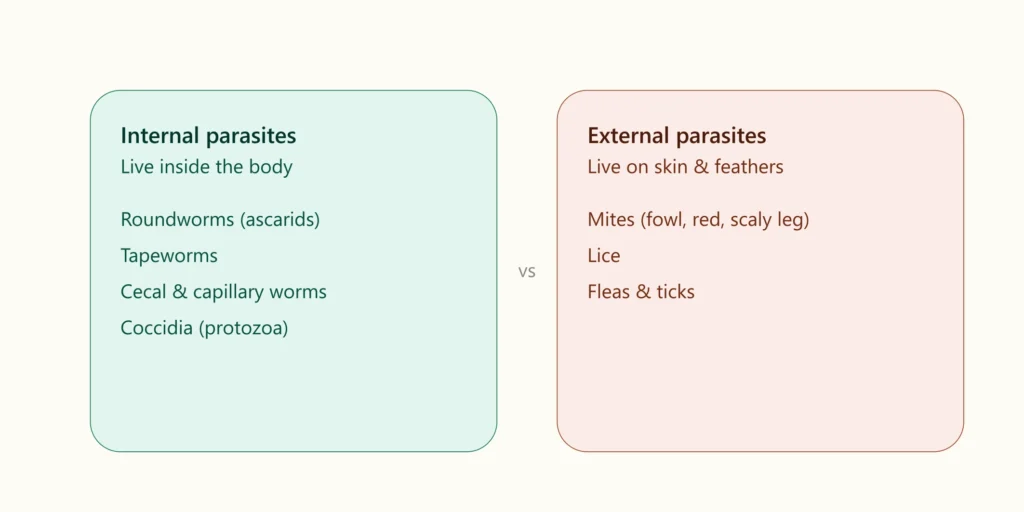
Poultry parasites fall into two broad classes. Internal parasites, or endoparasites, live inside the bird — mostly worms and protozoa in the digestive tract. External parasites, or ectoparasites, live on the bird’s skin and feathers, feeding on blood, dead skin, or feather debris. Most flocks will encounter both categories at some point, and a bird weakened by one is often more vulnerable to the other.
Internal vs. External Parasites: At a Glance
Before getting into individual species, it helps to see the two categories side by side. Internal parasites tend to cause slower, harder-to-spot damage — a bird can host a moderate worm burden for weeks before anyone notices anything’s wrong. External parasites are usually easier to catch early simply because you can often see them, or the damage they cause, just by parting a few feathers.
| Parasite Type | Category | Where It Lives | How It Spreads | Top Symptom | How It’s Diagnosed |
|---|---|---|---|---|---|
| Roundworms (Ascarids) | Internal | Small intestine | Ingesting infective eggs from droppings or soil | Weight loss, reduced growth | Fecal float test |
| Cecal worms | Internal | Cecum | Ingesting eggs, often via earthworms | Usually none directly (vector for blackhead in turkeys) | Fecal float test |
| Capillary (hair/crop) worms | Internal | Crop, esophagus, small intestine | Direct or via earthworms | Emaciation, bloody diarrhea | Fecal float test |
| Gapeworms | Internal | Trachea | Direct or via earthworms/slugs | Gasping, head-shaking, coughing | Visual/tracheal exam |
| Tapeworms | Internal | Small intestine | Requires an intermediate host (snails, beetles, flies) | Rice-grain segments in droppings | Visual ID of segments |
| Coccidia | Internal (protozoan) | Intestinal lining | Direct, via contaminated droppings | Bloody or watery diarrhea | Fecal float test |
| Northern fowl mite | External | Vent, tail, breast feathers | Bird-to-bird contact, wild birds | Anemia, feather loss | Visual inspection |
| Red (chicken) mite | External | Coop cracks by day, bird at night | Coop infestation, nocturnal feeding | Reluctance to roost, anemia | Nighttime coop inspection |
| Scaly leg mite | External | Under leg scales | Bird-to-bird contact | Raised, crusty leg scales | Visual leg inspection |
| Lice | External | Feathers, skin | Wild birds, new flock members | Constant preening, irritation | Visual inspection of feather base |
Common Internal Parasites in Chickens
Roundworms, technically called ascarids, are the most common internal parasite in backyard flocks and also among the most damaging. They live in the small intestine, growing large enough — sometimes a few inches — that a heavy burden can physically block the gut. A chicken picks these up by pecking at contaminated soil or droppings that contain infective eggs, which is a direct lifecycle: no middleman required.
Cecal worms are smaller and usually don’t hurt chickens much on their own, but they matter for a specific reason — they’re the main way blackhead disease reaches turkeys, which is why chickens and turkeys are typically kept apart. Capillary worms, sometimes called hair or crop worms for their thread-like shape, settle into the crop, esophagus, or small intestine and can cause real emaciation in heavy infections; they often rely on earthworms as an intermediate host.
Gapeworms are one of the more alarming-looking infections because of where they live — the trachea — which produces the “gape,” a wide, gasping stretch of the neck and beak that gives the parasite its name. Tapeworms are the odd ones out among the worms because they absolutely require an intermediate host, usually a snail, beetle, or fly, to complete their lifecycle; a chicken that never eats one of these carriers essentially can’t get tapeworms.
Coccidia deserve a mention here even though they’re a protozoan, not a worm, because they’re arguably the single most consequential internal parasite in poultry. Nine separate species affect chickens, and the resulting disease, coccidiosis, is common enough and serious enough that it gets its own dedicated coverage — treatment protocols and vaccination timing are best handled separately from this overview.
Common External Parasites in Chickens
Mites and lice cause most of the external parasite problems backyard keepers deal with, and they’re not the same kind of animal — a distinction that’s easy to miss. Mites are arachnids, close relatives of spiders, with eight legs and a body plan built for either blood-feeding or hiding in tight spaces. Lice are insects, and unlike most mites, they spend their entire life cycle on the bird rather than retreating to the coop.
Northern fowl mites live on the bird full-time, clustering around the vent, tail, and breast feathers, and they feed on blood aggressively enough to cause noticeable anemia in a bad infestation. Red mites, sometimes called chicken mites, do the opposite — they hide in coop cracks and crevices during the day and only climb onto roosting birds at night to feed, which makes them harder to catch unless you’re checking the coop with a flashlight after dark. Scaly leg mites take a different approach entirely, burrowing under the scales of a chicken’s legs and feeding on the tissue beneath. The result is legs that look thickened, crusty, and lifted at the scale edges, sometimes progressing to lameness if it goes untreated long enough.
Lice are the most frequently reported external parasite in chickens worldwide. Several species — feather louse, shaft louse, wing louse, body louse — all feed on dead skin, scabs, and feather debris rather than blood, and they’re identified by gently parting feathers near the vent and base of the wings to look for the insects themselves or their pale, glued-on eggs. Fleas and ticks show up less often in most regions but are worth a quick mention: fleas tend to cluster around the comb and wattles in warm months, while ticks bite and feed on blood and, in heavy infestations, can cause paralysis from the toxins they inject.
How Chickens Actually Get Parasites
Chickens get parasites in one of two ways: directly, or through an intermediate host. Direct transmission is the simpler of the two — a chicken pecks at droppings, soil, or bedding that already contains infective parasite eggs, and the cycle continues bird to bird within the flock. Roundworms and coccidia both spread this way, which is part of why crowded, damp, or poorly cleaned coops see more infections.
Indirect transmission adds a middle step. Certain worms — tapeworms especially, along with some capillary worms and gapeworms — can’t complete their lifecycle inside a chicken alone. They need to pass through an intermediate host first: an earthworm, snail, beetle, slug, or fly picks up the parasite’s eggs or larvae, and the chicken becomes infected only after eating that intermediate host. This is the actual mechanism behind a piece of advice every free-ranging keeper has heard — that letting chickens forage increases their parasite risk. It’s not the foraging itself that’s the problem; it’s that foraging means more contact with the exact insects and invertebrates that carry these parasites between hosts. A chicken confined to a clean, elevated coop has far fewer opportunities to eat an infected earthworm than one turned loose on damp pasture.
How Parasitic Diseases Differ from Bacterial and Viral Ones
Parasitic disease usually announces itself slowly, while bacterial and viral disease tends to move fast. A parasite has to establish itself, feed, and often reproduce over days or weeks before a bird shows real symptoms — gradual weight loss, a slow decline in egg production, feathers that look a little rougher than usual. Bacterial and viral illness, by contrast, more often spreads rapidly through a flock and produces sudden, visible symptoms in a matter of days.
The lifecycle complexity is another real difference. Several parasites — tapeworms, some capillary worms, gapeworms — require a completely separate host species to complete even one generation, which is a level of biological complexity bacteria and viruses simply don’t have. That complexity also shapes how each is diagnosed. Parasitic infections are typically confirmed with a fecal float or flotation test, which separates parasite eggs from a stool sample so they can be examined under a microscope. Bacterial and viral diseases are more often diagnosed through culture, PCR testing, or necropsy findings. If a flock is declining gradually and a fecal test comes back clean, it’s a reasonable signal to start looking at bacterial or viral causes instead.
Signs Your Chicken Has Parasites
Both internal and external parasites tend to produce a similar cluster of general symptoms, which is exactly why diagnosis matters more than guessing. Watch for weight loss despite normal appetite, a pale or shrunken comb and wattles (a classic sign of anemia), a drop in egg production or thinner shells, feather loss or damage outside of a normal molt, lethargy and general lack of interest in flock activity, and diarrhea that looks different from a healthy dropping.
That last symptom is worth its own closer look, because the appearance of a chicken’s droppings can actually point toward which parasite is involved before you even run a fecal test.
| Dropping Appearance | Likely Parasite Type | Also Watch For |
|---|---|---|
| Bloody, watery diarrhea | Coccidia or capillary worms | Lethargy, ruffled feathers, sudden onset |
| Slimy diarrhea | Large or nodular tapeworms | Weight loss despite eating |
| Small, rice-grain-like segments | Tapeworm proglottids | Visible segments on eggs occasionally |
| Visible whole worms | Roundworms (heavy infestation) | Reduced growth in young birds |
| Normal-looking but bird still declining | Possible external parasite (mites/lice) | Anemia, excessive preening, feather loss |
How to Check Your Flock for Parasites
A useful parasite check doesn’t require a lab — it just requires looking in the right places, consistently. Once a week, while you’re already handling birds for feeding or egg collection, run through a quick physical pass: check the comb and wattles for color (pale means possible anemia), part the feathers around the vent and under the wings for mites, lice, or nits, look over the legs for any raised or crusty scales, and feel the crop to make sure it’s neither hard nor unusually flat.
For internal parasites, the visual check only tells part of the story, since worms living inside a bird don’t show up on the outside until an infestation is fairly advanced. That’s where a fecal float comes in — a simple test that mixes a stool sample with a solution dense enough to make parasite eggs float to the surface, where they can be seen under a microscope. Most vets will run this even without a poultry specialty, and home kits exist for keepers who want to check more often. A reasonable rhythm is a fecal float every two to three months, paired with the weekly physical check, and either one immediately if a bird starts showing symptoms.
Prevention and Natural Remedies
Prevention comes down to a short list of habits, all aimed at breaking the paths parasites use to spread. Keep the coop and run clean and dry, since damp bedding and built-up droppings are exactly the conditions internal and external parasites thrive in. Offer a dust bath with diatomaceous earth, which helps birds manage mites and lice on their own. Quarantine any new bird for a few weeks before introducing it to the flock, since new arrivals are a common way parasites enter an otherwise clean coop. And keep feed and water elevated and covered, since ground-level access is an easy route for contamination.
Natural dewormers — garlic, pumpkin seeds, and apple cider vinegar are the most commonly mentioned — show up constantly in backyard-chicken circles, and some keepers swear by them. The evidence for their effectiveness is mixed and not well studied, so treat them as a possible supporting habit rather than a substitute for diagnosis. If you’re relying on a natural regimen, a fecal test is still the only real way to confirm it’s actually working. Specific dosing and treatment schedules — for both natural and chemical options — are covered in more depth in our dedicated articles on individual parasites.
When to Call a Vet
Most mild parasite loads resolve with basic hygiene and monitoring, but a few situations call for a vet rather than a DIY approach. Get help quickly if you see sudden, unexplained deaths in the flock, severe anemia (very pale or white combs and wattles), a bird that can’t stand or walk, or symptoms that keep getting worse despite treatment. A vet can also run a proper fecal exam and recommend medication with the correct dosing and withdrawal periods for eggs and meat, which matters more than most keepers expect.
FAQ
Can chicken parasites spread to humans? Direct risk is low. Research on backyard flocks has found no meaningful health risk to humans from the internal worms that affect chickens, and external parasites like lice and mites don’t live on human hosts even if they bite briefly. A few internal parasites carry rare zoonotic potential in unusual circumstances, but it isn’t a general household concern.
What parasites live on chickens? The main external parasites are mites (northern fowl, red, and scaly leg mites), lice, and occasionally fleas or ticks. Mites are arachnids that either live on the bird full-time or hide in the coop and feed at night, while lice are insects that spend their whole life cycle on the feathers.
What parasites live inside chickens? The most common internal parasites are roundworms, tapeworms, cecal worms, capillary (hair) worms, gapeworms, and coccidia. Most are worms living in the digestive or respiratory tract, except coccidia, which are single-celled protozoa that damage the intestinal lining.
How do I know if my chicken has worms? Look for visible worms or segments in the droppings, unexplained weight loss despite normal eating, and a decline in egg production. The only definitive way to confirm it, though, is a fecal float test, which shows parasite eggs under a microscope even before other symptoms appear.
Are natural remedies effective against chicken parasites? The evidence is mixed. Garlic, pumpkin seeds, and apple cider vinegar are widely used, but they haven’t been reliably tested the way approved dewormers have. If you use a natural regimen, a fecal exam is the only way to confirm it’s actually controlling the parasite load.
How often should I check my chickens for parasites? A quick visual check — combs, feathers, vent, legs — fits naturally into weekly flock care. Beyond that, a fecal float test every two to three months catches internal parasites before they become serious, and either check should happen immediately if a bird shows symptoms.
What’s the difference between mites and lice on chickens? Mites are arachnids with eight legs; some feed on blood and hide in the coop by day, while others live on the bird continuously. Lice are insects that spend their entire life cycle on the chicken, feeding on skin and feather debris rather than blood

One Response