
Signs of Gumboro Disease in Chickens
If your chicks have suddenly gone quiet, stopped eating, and started sitting in a huddle with ruffled feathers, Gumboro disease should be on your shortlist of suspects. It moves fast, it hits young birds hardest, and by the time you notice diarrhea staining the vent feathers, it’s often already spreading through the rest of the flock.
Gumboro disease — more formally known as Infectious Bursal Disease, or IBD — is a highly contagious virus that attacks a chicken’s immune system rather than any single organ you’d normally worry about. That’s what makes it dangerous even when a bird survives it: the damage to long-term immunity can outlast the visible symptoms by weeks. The disease gets its common name from Gumboro, Delaware, where it was first identified in 1962, and it’s since become one of the most economically significant poultry diseases worldwide.
This guide walks through the early and late signs, how the symptoms unfold day by day, which age groups are most at risk, how to tell Gumboro apart from diseases that look similar, and what you can realistically do about it.
What Are the Early Signs of Gumboro Disease?
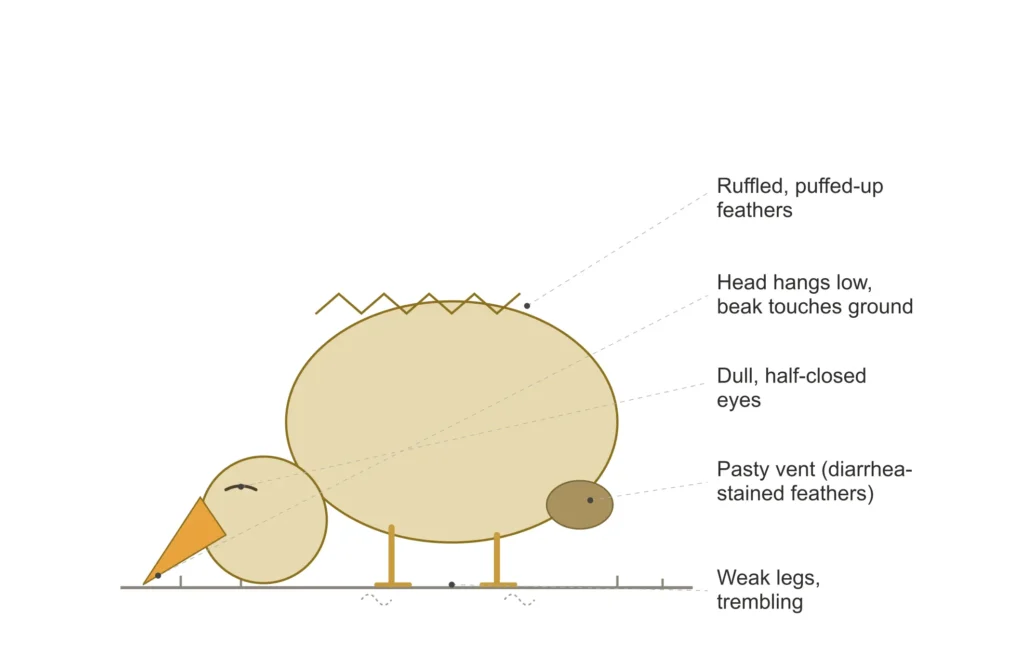
The first thing most keepers notice is a sudden drop in feed and water consumption — birds that were eating normally the day before suddenly lose interest. That’s usually followed within hours by depression, ruffled feathers, and a tendency to huddle together instead of moving around the pen normally.
Other early signs to watch for:
- Listlessness and an unsteady, wobbly gait
- Birds sitting in a hunched position rather than standing or walking
- A generally “unkempt” look across the flock — feathers out of place, birds bunched in corners
- Some birds sleeping with their beak resting on the floor, an unusual posture that several veterinary sources flag as a distinctive early tell
These signs typically show up 48 to 72 hours after a bird is infected, and because Gumboro is highly contagious, they tend to appear across much of the flock at roughly the same time rather than in just one or two birds.
What Are the Later, More Severe Signs?
As the infection progresses, the picture gets more obvious. Watery or whitish diarrhea — sometimes described as mucoid or slimy — starts staining the feathers around the vent, a pattern often called “pasty vent” or “pasty butt.” Affected chicks will frequently peck or pick at their own vent, likely in response to the irritation.
From there, expect:
- Trembling and visible weakness
- Progressive dehydration
- Reluctance to stand, or a further deterioration in coordination
- Rapid weight loss
- In severe cases, death — most commonly within a few days of the first visible signs
Reported mortality varies widely across sources, from as low as zero in mild cases up to 60% where a more virulent strain or a secondary bacterial infection is involved. A commonly cited figure for a typical clinical outbreak is around 20%, but treat any single number with caution — the real outcome depends heavily on the strain, the birds’ breed, and whether maternal antibodies offered any early protection.
Gumboro Symptom Timeline: What Happens Day by Day
Because Gumboro moves quickly, it helps to think about it in stages rather than as a single static list of symptoms.
| Day range | What’s happening internally | What you’ll actually see |
|---|---|---|
| Day 0–2 | Virus is replicating in the digestive tract and beginning to reach the bursa of Fabricius | No visible signs — this is the incubation period |
| Day 2–3 | Virus reaches peak activity in the bursa, the chicken’s key immune organ | Sudden drop in feed/water intake, depression, ruffled feathers begin |
| Day 3–5 | Bursa becomes swollen and inflamed, then starts to shrink; this is typically when mortality peaks | Diarrhea, vent picking, trembling, dehydration, weakness — the worst of the outbreak |
| Day 5–8 and beyond | Bursa continues shrinking toward roughly a third of its original size by around day 8; surviving birds begin recovering | Signs start easing; flock activity picks back up, though broiler weight gain typically stays delayed by 3–5 extra days |
Most flocks that survive the acute phase are visibly recovering within a week. That said, “recovered” doesn’t mean “unaffected” — the immune damage from this stage of the disease can linger well past the point where symptoms disappear.
At What Age Do Chickens Show Gumboro Symptoms?
Age matters enormously with Gumboro, mostly because of maternal antibodies — the passive immunity chicks inherit from their mother, which fades gradually over the first several weeks of life.
| Chicken type | Typical age of clinical onset | Notes |
|---|---|---|
| General / mixed backyard flock | 3–6 weeks | The widely cited window across veterinary sources |
| Broilers | Roughly 20–40 days | Faster growth rate tends to align with an earlier onset window |
| Pullets / laying hens | Roughly 30–80 days | Slower-maturing breeds can show signs later and over a wider window |
| Susceptible breeds (e.g., White Leghorn) | Occasionally up to 16–18 weeks | These breeds are noted as unusually susceptible even at older ages |
Chicks infected before roughly three weeks of age usually don’t show obvious symptoms at all — not because they’re unaffected, but because the infection tends to run subclinical at that age. That’s arguably the more dangerous scenario, and it deserves its own explanation.
Subclinical Gumboro: Signs You Might Be Missing
Not every Gumboro infection looks like an outbreak. When young chicks are infected very early — often before they’d show classic clinical signs — the disease can run silently. No dramatic diarrhea, no obvious die-off, nothing that immediately says “this flock has Gumboro.”
What you might notice instead:
- Slower or uneven growth across the flock compared to previous batches
- Poor feed conversion — birds eating normally but not gaining weight as expected
- A weaker-than-expected response to other vaccinations
- Unexplained vulnerability to secondary problems like E. coli infections, coccidiosis, or general “failure to thrive” that doesn’t have an obvious single cause
Several veterinary and poultry-industry sources consider this subclinical form more economically damaging over time than a visible outbreak, precisely because it’s so easy to miss. If a flock seems to be underperforming for no clear reason, and especially if it’s responding poorly to routine vaccination, subclinical Gumboro is worth ruling out.
How to Tell Gumboro Apart From Other Chicken Diseases
Diarrhea, lethargy, and huddling aren’t unique to Gumboro — several other common poultry conditions produce a similar-looking bird. Here’s a quick way to narrow things down.
| Disease | Overlapping signs | Key distinguishing sign |
|---|---|---|
| Coccidiosis | Diarrhea, lethargy, huddling, reduced appetite | Droppings are often visibly bloody; lacks Gumboro’s characteristic vent-picking and pasty-vent pattern, and responds to anticoccidial treatment |
| Newcastle disease | Depression, ruffled feathers, reduced flock activity | Typically brings respiratory signs (gasping, coughing) or nervous-system signs (twisted neck, tremors) that Gumboro doesn’t usually cause |
| Marek’s disease | Weakness, poor condition | Tends to affect older birds and causes progressive leg or wing paralysis and visible tumors — a much slower-developing picture than Gumboro’s sudden onset |
| Mycotoxicosis (moldy feed) | Poor growth, depressed immunity | Tied to a specific feed source rather than spreading bird-to-bird, and doesn’t follow Gumboro’s sharp 48–72 hour onset pattern |
If you’re genuinely unsure, this is exactly the situation lab diagnostics exist for — bursal histopathology, PCR testing, or serology can confirm Gumboro specifically rather than leaving you to guess from symptoms alone.
Should You Call a Vet? Red-Flag Signs
Most Gumboro cases can be managed with supportive care at home, but a few situations warrant getting a vet or diagnostic lab involved right away:
- Mortality climbing above roughly 20–30% within just a few days
- Bloody droppings, which can point to a more severe strain or a coccidiosis co-infection
- Signs spreading through the entire flock within 24–48 hours rather than a handful of birds
- Any uncertainty about whether you’re dealing with Gumboro versus a look-alike disease, especially Newcastle disease, which has different — and more urgent — control implications
Isolating sick birds immediately, regardless of the eventual diagnosis, is rarely the wrong move while you figure out what’s going on.
What Causes Gumboro Disease and How Does It Spread?
Gumboro is caused by the infectious bursal disease virus (IBDV), a small, non-enveloped virus in the Birnaviridae family. It spreads primarily through the fecal-oral route — birds pick it up by ingesting contaminated feces, feed, water, or litter.
What makes it particularly hard to eliminate once it’s on a property:
- The virus can survive for more than 50 days in feed, water, manure, and even insects like darkling beetles
- It can persist in an empty poultry house for four months or longer after an infected flock has been removed
- It spreads readily between houses on contaminated boots, equipment, and clothing
- There’s no evidence of vertical transmission from hen to egg, but horizontal spread between birds and between flocks is extremely efficient
Because of how resilient the virus is in the environment, a single bad outbreak can leave a coop “hot” for months unless it’s properly cleaned and rested.
Is There a Treatment for Gumboro Disease?
There’s no antiviral cure for Gumboro — antibiotics don’t touch the virus itself, though they’re sometimes used to manage secondary bacterial infections that take advantage of a weakened immune system. Treatment is almost entirely supportive:
- Isolate sick birds from the rest of the flock immediately to slow the spread.
- Rehydrate with electrolyte solutions to counter the fluid loss from diarrhea.
- Support nutrition with vitamin supplementation, and hand-feed soft feed if a bird has stopped eating on its own.
- Manage pasty vent by gently cleaning the area with warm water to prevent blockages, which can otherwise be fatal on their own.
- Keep the environment calm — reduce stress, maintain a comfortable temperature, and avoid crowding.
Some research has explored more targeted interventions, including corticosteroids in controlled veterinary settings, but these require professional guidance rather than home dosing. The realistic goal of home care is to get birds through the acute phase with as little additional stress and dehydration as possible, while their own immune system does the recovering.
How to Prevent Gumboro Disease
Given that there’s no cure, prevention is where the real leverage is — and it rests on two pillars: vaccination and biosecurity.
Vaccination works by building either passive immunity (via the breeder flock, passed to chicks through maternal antibodies) or active immunity (via direct vaccination of chicks). Several vaccine types exist, each with different tradeoffs:
| Vaccine type | When typically given | How administered |
|---|---|---|
| Conventional live attenuated | Usually two doses during rearing | Eye drop, drinking water, or spray, depending on brand |
| Immune-complex (live virus + antibody) | Single dose | Usually at the hatchery |
| Recombinant HVT-based | Single dose | In ovo or at hatch, at the hatchery |
| Inactivated | Booster in breeder flocks | Injection, to extend passive protection to progeny |
Exact timing matters a lot here, because vaccinating too early — while maternal antibodies are still high — can neutralize the vaccine before it does any good, while vaccinating too late leaves a window where chicks are unprotected. Some vaccination programs use a schedule around day 5, day 14, and a day-23 booster, but the right timing depends on your specific vaccine, region, and the maternal antibody levels in your flock — this is genuinely worth confirming with a vet or your vaccine supplier rather than copying a schedule from elsewhere.
Biosecurity matters just as much given how resilient the virus is in the environment:
- Use footbaths and dedicated footwear per poultry house
- Thoroughly clean and disinfect between flocks, with an adequate rest period before restocking
- Control rodents and darkling beetles, which can carry the virus between flocks
- Avoid mixing age groups, and isolate newly introduced birds for at least a couple of weeks
Frequently Asked Questions
What is the very first sign of Gumboro disease in chickens? The earliest visible sign is usually a sudden drop in feed and water intake, followed within hours by depression and ruffled feathers. Watery or whitish diarrhea and vent picking typically follow as the disease progresses over the next one to two days.
How long does Gumboro disease last in chickens? Clinical signs appear 48–72 hours after infection, peak around day 3–5, and surviving birds usually recover within a week. Broiler weight gain, however, stays delayed by an extra 3–5 days even after visible recovery.
Can chickens survive Gumboro disease? Yes — mortality in clinical outbreaks is commonly cited around 20%, though it can range much higher if secondary infections set in, and much lower in mild or well-managed cases. Most surviving birds recover within a week but may carry long-term immune suppression.
Is Gumboro disease contagious to other chickens? Yes, it’s highly contagious and spreads fecal-orally through contaminated feed, water, litter, and equipment. The virus is unusually resistant, surviving weeks in the environment and months in an empty poultry house.
Can Gumboro disease be treated? There’s no antiviral cure. Treatment is supportive only — isolation, electrolytes, vitamins, and antibiotics for secondary bacterial infections — while vaccination remains the primary way to prevent outbreaks.
At what age are chickens most at risk for Gumboro disease? Chickens are most susceptible to clinical disease between 3 and 6 weeks of age, though broilers commonly show signs at 20–40 days and layers or pullets somewhat later, around 30–80 days.
How is Gumboro disease different from coccidiosis? Both can cause diarrhea and lethargic, huddled birds, but coccidiosis diarrhea is often visibly bloody without the vent-picking and pasty-vent pattern typical of Gumboro, and it responds to anticoccidial treatment rather than following Gumboro’s characteristic sudden-onset, flock-wide course.
This article is for general informational purposes and isn’t a substitute for veterinary diagnosis. If you suspect a Gumboro outbreak, especially with rising mortality or uncertainty about the diagnosis, a poultry vet or diagnostic lab can confirm it and guide next steps